What is an ERP? A practical guide for SMEs
An ERP — Enterprise Resource Planning system — is the software backbone that connects a company's core processes into a single source of truth. Finance, sales, inventory, procurement, HR and reporting stop living in separate spreadsheets and start sharing one database, so every team works from the same numbers in real time.
For SMEs across Saudi Arabia and the MENA region, an ERP is what turns scattered operations into a controlled, auditable business. It enforces consistent workflows, automates repetitive tasks, and produces the financial data and e-invoicing records that regulators like ZATCA increasingly require.
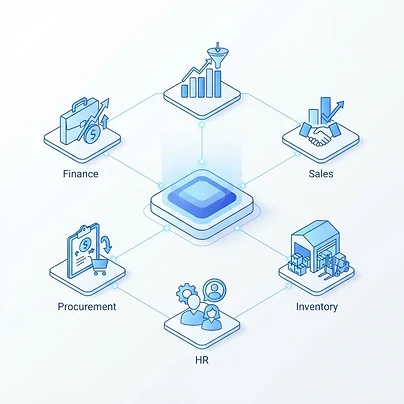
That is why adopting an ERP matters from the very beginning of a company, not just once it has grown large. When processes are defined on a single platform early, data stays consistent from the first invoice, mistakes are caught before they scale, and the business builds auditable habits rather than retrofitting them later under compliance pressure.
An ERP is built from modules — the core ones every company needs and the advanced ones it grows into. Core modules include accounting, sales and CRM, purchasing, inventory and warehouse, and basic reporting — the functions that keep the lights on. Advanced modules add manufacturing, HR and payroll, project management, field service, eCommerce, point of sale, and analytics — switched on as the business model demands, so the platform grows with the company instead of being over-bought on day one.
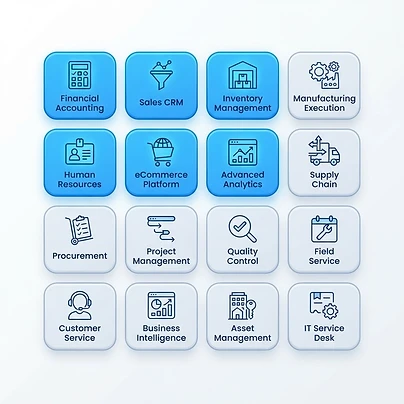
This makes the ERP the foundation of any digital transformation journey. Digital transformation is not a website or a dashboard; it is the move from disconnected tools and tribal knowledge to integrated, data-driven processes. The ERP is the central system those processes run through, so transformation initiatives — automation, AI analytics, e-invoicing, omnichannel sales — connect to a reliable source of truth rather than another silo.
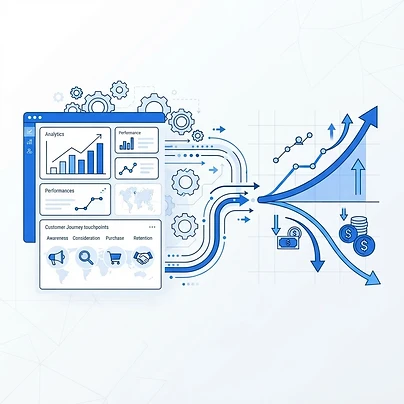
The business impact shows up where it matters most: smoother operations, better customer experience, higher sales and lower costs. Operations run leaner because manual handoffs and duplicate data entry disappear. The customer journey improves because quotes, orders, deliveries and after-sales service share one record, so customers never have to repeat themselves. Sales rise through faster quoting, upsell visibility and connected eCommerce channels. And costs fall through automation, fewer errors, lower inventory carrying and tighter spend control — the combination that makes an ERP one of the clearest ROI decisions a growing company can make.

Not every ERP fits every business, and the market spans very different shapes and price points. SAP ERP and Oracle ERP (including Oracle Fusion Cloud ERP and NetSuite) are built for large, complex enterprises — powerful, but heavy in cost, customisation and implementation time. Microsoft ERPs — Dynamics 365 Business Central for the mid-market and Dynamics 365 Finance & Operations for larger firms — sit in the upper-mid-market, tied closely to the Microsoft ecosystem.
At the SME and mid-market end, modern platforms are far more accessible. Odoo is a modular, open-source ERP where you switch on only the apps you need — from accounting and inventory to POS, eCommerce and CRM — making it ideal for growing businesses that want to start lean and expand. ZAD ERP is a Saudi-built, Arabic-first ERP engineered for local compliance (including ZATCA e-invoicing) and multi-branch operations out of the box. Rennt ERP is a specialised Oracle-based ERP for property and rental management firms that need real-estate-specific workflows.
Choosing comes down to three questions: How large and complex is your operation? How important are local compliance and an Arabic-first experience? And how quickly do you need to go live? Enterprise suites like SAP and Oracle reward scale with depth but demand patience and budget; Odoo and ZAD ERP reward speed and flexibility with faster time-to-value and a lower total cost of ownership.
The right ERP is the one that fits your operating model today and can grow with you tomorrow — without locking you into a footprint you can neither afford nor fully use. As an official Odoo partner delivering ZAD ERP, Rennt ERP and custom integrations across the region, ALX Solutions helps SMEs across Saudi Arabia and the GCC choose and implement the ERP that genuinely fits.